
End-of-Life & End-of-Service IT hardware at IT-Planet
When manufacturers end the life cycle of a product, suitable hardware often becomes difficult to find. IT-Planet offers you a wide selection of end-of-life (EOL) and end-of-service (EOS) devices - tested, available and ready for use - even after the official product end date.
End-of-Life (EOL) and End-of-Service (EOS)
What does this mean and what should be considered with regard to the IT infrastructure?
IT hardware has a limited lifespan. However, this is not only determined by defects that render the devices unusable. In addition, manufacturers determine how long customers should use the devices. They develop new models again and again. In return, they then discontinue support for the previous versions.
There are many reasons for this - from new market requirements to the introduction of innovative technologies. Of course, they also want to increase their sales and persuade customers to buy a new device. In this context, the terms EOL and EOS are often heard.
However, users often do not know exactly what they should understand by this and what impact this has on their IT infrastructure. Therefore, we present here what these abbreviations mean.

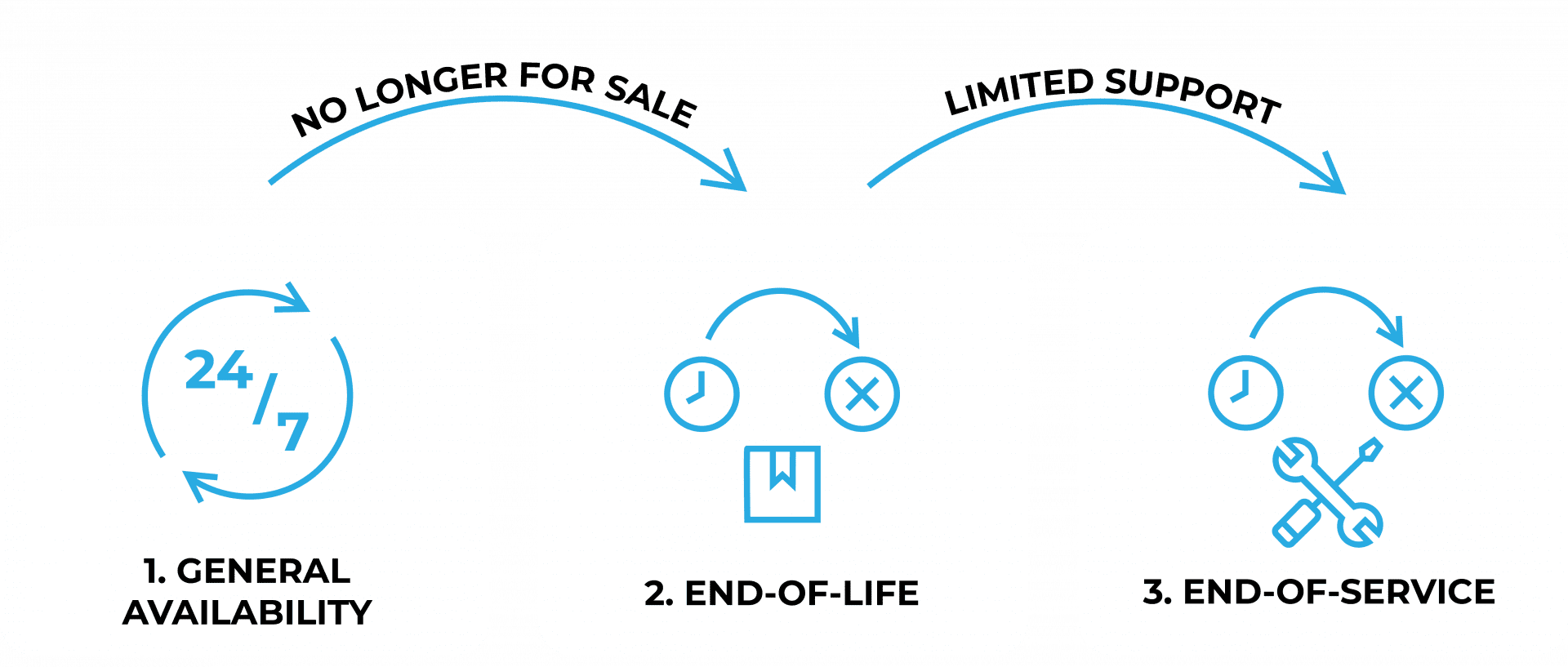
End-of-Life (EOL)
The term EOL stands for “end-of-life” and describes the life cycle of products from the transition from series production to discontinuation. This refers to the point in time at which suppliers cease production of the device in question and no longer supply it. It is therefore no longer possible to purchase it - not even as a replacement for existing systems that use the corresponding model.
The date of discontinuation will be announced in good time so that there is sufficient time to switch to newer solutions or services. Despite the end of active production or sale, existing devices can still be used without any problems. There will also continue to be a comprehensive range of support for the devices to ensure smooth operation.
End-of-Service (EOS)
The abbreviation EOS usually stands for End-of-Service or End-of-Support, which is largely synonymous. However, caution is advised here, as some providers use this abbreviation for end-of-sale. This corresponds to the production and sales stop that we have just described as the end-of-life of a product. Therefore, it is important here to always pay attention to the exact meaning in order to avoid misunderstandings.
If you interpret the abbreviation EOS as End-of-Service or End-of-Support, it means that the supplier stops supporting the devices. It is still possible to use them. However, there may be certain security risks in doing so. Nevertheless, there are cases where it is still worthwhile to continue using them. In this case, however, the user is responsible for the maintenance and security of the devices.
IT-Planet: the right partner also for EOL and EOS devices
Even if an individual device has reached end-of-life or end-of-service, it often makes sense to continue using it. To convert the entire system would be very costly. However, it is often difficult to find suitable offers for this. At IT-Planet, however, we also offer suitable solutions in this area. We have a wide range of EOL and EOS devices available for you. This often allows you to replace the previous hardware / network technology and in this way continue to use the system without any adjustments.