
Bring relevant systems together centrally
Network devices, servers, applications, cloud services, storage solutions and other components can be displayed in a shared interface, depending on the available interfaces and sensors.
With PRTG, you can monitor networks, servers, applications, cloud services and other IT components from one central solution. IT-Planet helps you realistically determine the number of sensors you need and select a licence size that fits your existing infrastructure as well as potential future expansions.
PRTG brings together important status and performance data from your IT infrastructure in one central monitoring interface.
Custom thresholds and notifications help your IT team identify unusual developments, performance bottlenecks and outages at an early stage. Historical measurement data and clear dashboards also provide a solid basis for root cause analysis, capacity planning and the long-term optimisation of your systems.
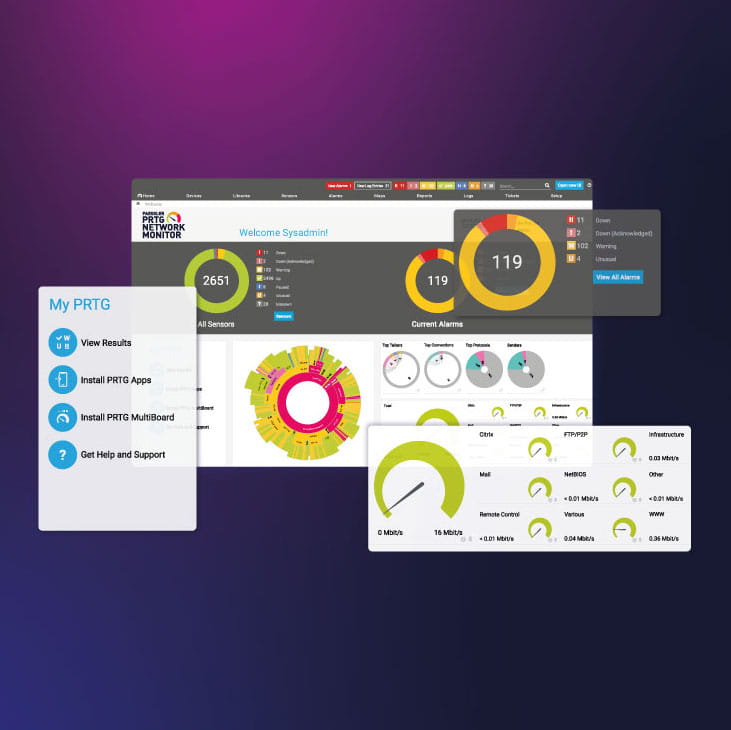
PRTG brings together measurement data from different areas of your infrastructure in one central monitoring environment. This gives IT teams a shared view of technical conditions, dependencies and unusual developments – even across multiple systems and locations.
Network devices, servers, applications, cloud services, storage solutions and other components can be displayed in a shared interface, depending on the available interfaces and sensors.
A medium-sized company operates several locations with switches, firewalls, virtual servers, Microsoft 365, internal applications and production systems. PRTG provides the required measurement data centrally and supports the IT team with monitoring across multiple locations.
For example, if CPU utilisation remains high over an extended period, a service fails or a storage device reaches a defined threshold, PRTG can trigger a notification via configured channels. This gives the IT team an early warning and allows them to assess the situation more accurately using current and historical measurement data.
The number of sensors required is the key factor when choosing a licence. Each sensor monitors a specific metric or aspect, such as CPU utilisation, storage space, a service or network traffic.
| Licence | Sensors | Approx. number of devices | Suitable for | Product |
|---|---|---|---|---|
| PRTG 500 | Up to 500 | approx. 50 devices | Smaller environments or an entry point into centralised monitoring | View product |
| PRTG 1000 | Up to 1,000 | approx. 100 devices | Small to medium-sized IT environments | View product |
| PRTG 2500 | Up to 2,500 | approx. 250 devices | Medium-sized infrastructures with extended monitoring requirements | View product |
| PRTG 5000 | Up to 5,000 | approx. 500 devices | Large and more complex IT environments | View product |
| PRTG 10000 | Up to 10,000 | approx. 1,000 devices | Very large environments with extensive requirements | View product |
 Advice from a Paessler Gold Partner
We support you with sensor planning, licence sizing and appropriate reserves for future growth.
Advice from a Paessler Gold Partner
We support you with sensor planning, licence sizing and appropriate reserves for future growth.

The right licence is determined not only by the number of devices, but by the number of metrics and services you actually want to monitor.
As a Paessler Gold Partner, IT-Planet supports you in assessing your monitoring requirements in a structured way. Together, we look at your devices, locations, applications and the metrics you want to monitor. This provides a better basis for determining how many sensors are required and which licence size offers sufficient capacity for future expansion.
Here you will find answers about sensors, licence sizes, possible applications, alerts and the integration of PRTG into existing IT environments.
PRTG can monitor networks, servers, virtual machines, applications, databases, cloud services, bandwidth, storage systems, UPS systems and IoT devices, among other things. Which systems can be integrated depends on the available interfaces and sensor types.
A sensor monitors a specific metric or aspect of a device. This could be the CPU utilisation of a server, available storage space, the availability of a service or network traffic on an interface. A single device therefore often requires several sensors.
The right licence primarily depends on the number of sensors required rather than simply the number of devices. The key factor is which metrics and services need to be monitored on each device. For realistic planning, devices, applications and required measurement points should therefore be considered together.
If your IT environment grows or additional systems need to be monitored, it may become necessary to switch to a larger licence. It therefore makes sense to consider possible future expansions and additional monitoring requirements when selecting the licence.
Custom thresholds and notifications can be configured for sensors. In the event of issues, outages or threshold violations, PRTG can notify the responsible IT team, for example by email, push notification or other configured notification channels.
Yes. PRTG can be used to centrally monitor distributed IT infrastructures. Systems at different locations can be displayed and analysed within a shared monitoring environment.
Cloud services and platforms can be integrated into the monitoring environment depending on the available sensors and interfaces. Examples include Microsoft 365 as well as services from Azure or AWS environments.
PRTG offers numerous preconfigured sensors and can be adapted to different IT environments using interfaces, templates and custom sensors. The exact scope depends on the systems in use and their available technical integration options.
No. In most cases, several sensors are used per device. A server may require separate sensors for CPU, memory, storage, network connections and individual services. This is why the number of sensors is particularly important when planning the licence.
Yes. We help you estimate the licence size you need, taking into account the number of devices, planned sensors, your infrastructure and possible future expansions. You can send us the most important project details via our request form .